
Krav Maga & Krav Maga Yashir
 One of the central/core disagreements over the term “Krav Maga” occurred between the founder Imi Lichtenfeld, and his next in-line, Eli Avikzar. Imi wanted to keep the term generic,
allowing different instructors to take the “approach” and use it in a variety of different ways. Eli’s concern was that people wouldn’t be able to distinguish and evaluate one
system of Krav Maga from another. With Imi’s blessing, Eli started to refer to the Krav Maga that he taught as “Krav Magen” (meaning Combat Shield in Hebrew). It was the same system
that he inherited/had learnt from Imi, but it meant that it could be differentiated from other instructor’s interpretations of Imi’s principles. Whilst at the time (1980’s and 1990’s)
this wasn’t so much of a concern in the early 2000’s it started to become one.
One of the central/core disagreements over the term “Krav Maga” occurred between the founder Imi Lichtenfeld, and his next in-line, Eli Avikzar. Imi wanted to keep the term generic,
allowing different instructors to take the “approach” and use it in a variety of different ways. Eli’s concern was that people wouldn’t be able to distinguish and evaluate one
system of Krav Maga from another. With Imi’s blessing, Eli started to refer to the Krav Maga that he taught as “Krav Magen” (meaning Combat Shield in Hebrew). It was the same system
that he inherited/had learnt from Imi, but it meant that it could be differentiated from other instructor’s interpretations of Imi’s principles. Whilst at the time (1980’s and 1990’s)
this wasn’t so much of a concern in the early 2000’s it started to become one.
When Krav Maga started to become commercialized with “instructors” simply referring to what they taught as being Krav Maga, the term Krav Maga started to become devalued, and it became necessary – as Eli Avikzar had predicted – to use a more specific term to refer to what was being taught as the generic use of “Krav Maga” started to lose meaning e.g., martial arts instructors who had no knowledge of what Krav Maga was, began teaching their interpretation of the approach based on what they had read in books, and had seen on YouTube etc. Something that unfortunately continues to this day. Rather than try to “fight” all of these interpretations that used the term Krav Maga, Gershon Ben Keren, stopped referring to what he taught as being simply Krav Maga, and started referring to it as Krav Maga Yashir. The term “Yashir” in Hebrew has two meanings. It translates, literally, as “Direct”, but the directness also implies honesty, openness and transparency i.e., there is nothing “hidden”. Krav Maga Yashir is simply Krav Maga as it was intended to be.
The Krav Maga Yashir program is made up of 4 components. These are: Reality Based Self Defense Program, Movement, Striking & Blocking Program, Self-Protection & Personal Safety Program and a Combat Fitness/”Cosher Kravi” Program.
 The Krav Maga Yashir system is based and founded on sound common combat principles, and teaches these to a specific methodology. It is this which makes it a distinct system, as opposed to a
collection of disparate techniques. All of the techniques within the system adhere to these principles, and interlock together to create a comprehensive system of self-defense. Because of
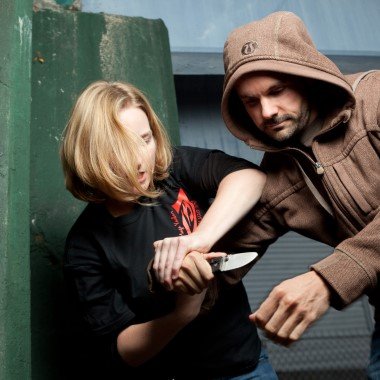
this adherence to principle, reuse of techniques is possible, and certain techniques are almost interchangeable e.g. a knife control or disarm can be used as a gun disarm and vice versa.
Below is a list – not exhaustive – and explanation of some of the concepts and principles upon which the Krav Maga Yashir system is founded.
The Krav Maga Yashir system is based and founded on sound common combat principles, and teaches these to a specific methodology. It is this which makes it a distinct system, as opposed to a
collection of disparate techniques. All of the techniques within the system adhere to these principles, and interlock together to create a comprehensive system of self-defense. Because of
this adherence to principle, reuse of techniques is possible, and certain techniques are almost interchangeable e.g. a knife control or disarm can be used as a gun disarm and vice versa.
Below is a list – not exhaustive – and explanation of some of the concepts and principles upon which the Krav Maga Yashir system is founded.
Krav Maga & Pre-emptive Striking
If a person points a gun at your head you don’t need (or want) to wait to see if the pull the trigger to confirm that they have harmful intent towards you, equally if a person is displaying an array of Pre-Violence Indicators (PVI’s) towards you, you don’t need to wait for the inevitable punch or attack before dealing with them. Pre-emptive striking is taught from day-one in the Krav Maga Yashir system, based off of the understanding that the person who attacks first has the advantage, and this is something you don't want to give to an assailant but instead claim it for yourself.
Krav Maga - Attack At The Earliest Opportunity
It is impossible to survive a real-life conflict by having a defensive mindset and only focusing of dealing with the assailant’s attacks. To survive, an assailant has to be taken out of the fight as quickly as possible. This involves either inflicting enough pain and damage that they emotionally take themselves out of the fight, or physically incapacitating them by destroying limbs or putting an assailant unconscious (by knocking them out or choking/strangling them out). These actions should be taken as quickly as possible, as the longer the duration of the fight, the more likely a person is to suffer injury, or see their assailant aided by third parties etc. This is why an attack should be made as soon as possible, after a defense – a person should work offensively not defensively. Every defense movement or technique should form part of an attack.
Krav Maga - Defense as Attack
In Krav Maga Yashir there are no “Defensive” movements, every movement and technique in its intent is an attack. When a block is performed against a punch, a stab or a slash, the blocking arm is intended to cause as much trauma to the attacker’s arm as possible. Rather than just be a defensive movement the blocking arm is looked upon as an attack. By having defensive movements that cause pain and damage to an assailant, it causes them to hesitate when making future attacks, as they are aware of the potential pain that will accompany their next assault, as well as take away the timing of their strikes (this is important when dealing with knife attacks, where the knife will be recoiled and reset after an initial stab or slash) etc.
Krav Maga - Hand Defense/Body Defense
 In a real life conflict, especially when a person is surprised, it is unrealistic to expect that they will perform every technique 100 %. This means some form of contingency needs to be built in.
Rather than rely purely on a hand or arm to make a complete defense, a body defense is associated so that if the hand defense isn’t fully effective the body defense will compensate. The idea
is that if the hand-defense is performed perfectly (100% defense) and the body-defense is performed perfectly (100% defense), there is effectively a 200% defense in place.
In a real life conflict, especially when a person is surprised, it is unrealistic to expect that they will perform every technique 100 %. This means some form of contingency needs to be built in.
Rather than rely purely on a hand or arm to make a complete defense, a body defense is associated so that if the hand defense isn’t fully effective the body defense will compensate. The idea
is that if the hand-defense is performed perfectly (100% defense) and the body-defense is performed perfectly (100% defense), there is effectively a 200% defense in place.
Combined with this is the concept that the body defense should be used to put the person defending an assault into a position where they can launch their own attack e.g. attack, should follow defense as quickly as possible.
Krav Maga - Soft Strikes into Hard Strikes
The Krav Maga Yashir system breaks striking down into two halves: soft strikes & hard strikes. A soft strike is one which doesn’t require any power to have an effect, such as an eye strike or groins strike – these targets can be hit with a “soft” striking tool such as the fingers, or the back of the hand. Hard strikes, use hard striking surfaces, such as the fists, elbows, shins or knees etc. To be effective, these generally require the body to be aligned and positioned so that it is able to generate power, something which is often difficult to achieve in the initial moments of a confrontation – especially if a person is surprised. This is why the Krav Maga Yashir system advocates the initial use of soft strikes, such as eye and groin strikes to disrupt an assailant, and as these are thrown, the body can be positioned to follow up with hard strikes that can disable an assailant.
The Krav Maga Yashir system follows the continuum: disrupt, damage, destroy and disengage. The first strikes that are thrown should be ones that have the greatest chance of disrupting an attacker, and take into account that fact that a person is usually surprised and not in the optimum position to deliver powerful strikes. A bad eye strike, is much more effective than a bad punch, so the chances of having a better effect with an eye strike than a punch in the first moments of a fight means that such a strike is favored – as would a groin slap, or throat strike (all strikes that don’t have to land perfectly to disrupt an assailant’s attack). After these initial “soft strikes” have been thrown, disrupting an assailant’s attack, and allowing for the body to be properly aligned, “hard” power strikes are used to finish the fight.
The Use of Natural Reflexive & Instinctive Movements
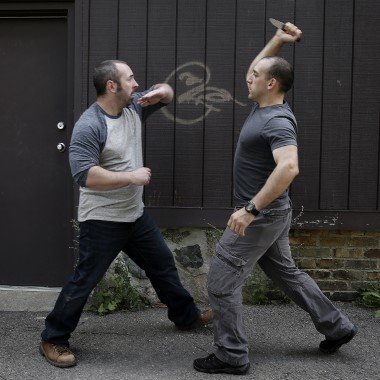 The body naturally has certain inbuilt defensive mechanisms that it uses to instinctively protect itself from a variety of threats and attacks e.g. we will naturally bring are hands to our throat, if we are
being choked or strangled and flinch when we catch fast movement crossing into our peripheral vision. Krav Maga Yashir uses these movements as the foundation for many of its defenses.
The body naturally has certain inbuilt defensive mechanisms that it uses to instinctively protect itself from a variety of threats and attacks e.g. we will naturally bring are hands to our throat, if we are
being choked or strangled and flinch when we catch fast movement crossing into our peripheral vision. Krav Maga Yashir uses these movements as the foundation for many of its defenses.
There are many things that we may lie to think we would do when attacked, and then there are those things that we will do i.e. our natural reflexive movements. Rather than try and build “new” responses, the Krav Maga Yashir system builds on these natural movements creating what are called “Assemblies”, which are trained and learnt movements associated with reflexive ones e.g. when we flinch because somebody throws a punch or makes a slashing attack with a knife, the natural arm movement is used to block whilst a “trained” movement, moving to the side and towards the attacker is added; creating an assembly.
Krav Maga: Life Threatening Attacks – Attack the Attack
In Krav Maga Yashir the first and primary goal is to make yourself safe, before you attack the assailant. There is little use trying to attack an attacker if they are in the process of choking you out. Your priority is to clear the choke and then attack your assailant. If the attack, is a lapel, wrist or clothing grab, it is non-life threatening and so the attacker can be assaulted without clearing the grab.
This leads to the principle, “if it is a life-threatening attack, attack the attack, if it is a non-life threatening attack, then attack the attacker.”
Krav Maga - Use of the Environment
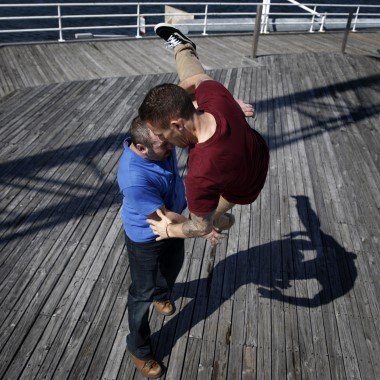 A fight is not something that happens in a vacuum. Despite mostly training in matted environments, where the floor is even and there are no natural tools that could be used as improvised weapons, the real world is
full of objects that could be used in both an offensive and defensive manner. Krav Maga Yashir practitioners are taught how to use common objects for their own defense, and that these should often be the first
things that are used when threatened or attacked.
A fight is not something that happens in a vacuum. Despite mostly training in matted environments, where the floor is even and there are no natural tools that could be used as improvised weapons, the real world is
full of objects that could be used in both an offensive and defensive manner. Krav Maga Yashir practitioners are taught how to use common objects for their own defense, and that these should often be the first
things that are used when threatened or attacked.
A parked car, can be used to create an effective defensive barrier to prevent an assailant getting close to us, tables and other pieces of furniture can be used in the same way. Improvised weapons are categorized in the following way:
- “Hafatzim dmooyey magen” - “objects, similar to shield” (such as bags, chairs)
- “Hafatzim dmooyey even” - “objects, similar to rock/stone” (such as snooker balls, bottles)
- “Hafatzim dmooyey sakkin” - “objects, similar to knife” (such as scissors, keys, broken bottles)
- “Hafatzim dmooyey makel” - “objects, similar to stick” (such as scaffolding, snooker cues)
- “Hafatzim Ktanim” – “small objects” (such as coins, pebbles, sand and gravel)
- “Hafatzim dmooyey Hevel” - “objects, similar to chain”
By understanding how to categorize objects in this manner, a practitioner can look at their environment and understand not only what can be used as a weapon but how it should be used as well. If a student is trained in offensive stick fighting, then they will also know how to use other objects that resemble a stick.
Krav Maga - Expect Anything
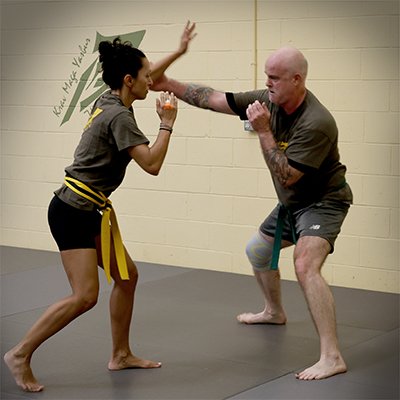 A fight is not a combat sports match where there are rules, and participants know what to expect from each other. In a real-life conflict, anything can happen e.g. a knife can be pulled when on the ground as well as
when standing. If you only train to expect certain things, then when the unexpected happens you will find yourself both surprised and unprepared. Three basic assumptions that are taught in the Krav Maga Yashir
syllabus are:
A fight is not a combat sports match where there are rules, and participants know what to expect from each other. In a real-life conflict, anything can happen e.g. a knife can be pulled when on the ground as well as
when standing. If you only train to expect certain things, then when the unexpected happens you will find yourself both surprised and unprepared. Three basic assumptions that are taught in the Krav Maga Yashir
syllabus are:
- Always assume your assailant is armed, even if you have disarmed them (they may have another weapon) or you can’t see a weapon.
- Always assume you are dealing with more than one assailant, even if your primary attacker seems alone.
- Assume your assailant is technically and physically competent to deal with both your defenses and attacks.
Working from these 3 assumptions you should be prepared to deal with any situation you have to face, and should not be surprised if/when the direction of the conflict changes.
The Krav Maga Yashir system uses all of the above principles and concepts (as well as others) to design and modify its techniques as well as its approach to real-life violence, so that it provides comprehensive and effective solutions to real-world violence. It also teaches students how to predict, identify and avoid violence in the first place, using a system of Self-Protection.
Krav Maga Self-Protection & Personal Safety
It is far easier to avoid becoming a victim of a violent assault than it is to deal with one, especially if it involves weapons and multiple assailants. By teaching practitioners how violent assaults occur and what prior steps assailants need to take in order to launch an assault, students of Krav Maga Yashir are taught how to predict and avoid violence before it occurs. To read more about this approach, please click here (this will take you to the SEPS - Situation Effective Protection System - website).
Combat Fitness/”Cosher Kravi”
Reality Based Self-Defense is comprised of three components: simple, effective techniques, an aggressive mindset and physical fitness. Once a person’s adrenaline is used up, all that they are left with is their underlying physical fitness. If this is lacking, and they don’t have the necessary gas in the tanks, it matters little how technically competent they are. Being able to function in an exhausted state is something that is necessary if a person is to survive a real-life encounter. Our Combat Fitness program prepares the practitioner for that reality.