Gun Threat
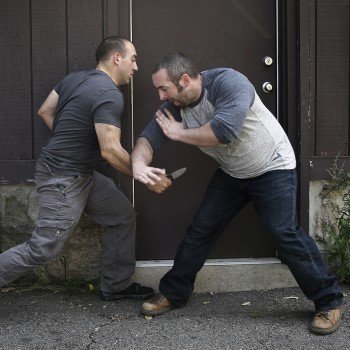
There are many sililarities between the "combative" solutions when dealing with both gun and knife threats e.g., the weapon and/or weapon arm is controlled...

 This is a question something that many Krav Maga practitioners today have difficulty answering as many instructors professing to teach Krav Maga aren’t able to answer this question either.
People will often answer that it isn’t a martial art but a reality-based self-defense system, which in some regards is true, however there are many reality-based self-defense systems that
wouldn’t conform to the definition of what Krav Maga is. In short Krav Maga is the “art” of Imi Lichtenfeld, along with those who were instrumental in creating the approach/method. It may
be better to think of Krav Maga as being an approach to fighting rather than a “system” of fighting. What differentiates Krav Maga from other reality-based self-defense systems is that Imi
Lichtenfeld and those who worked with him, created a framework of fighting concepts that would define the systems of fighting that were built upon them. This is why there can be a degree of
variation in some of the techniques and solutions that were created using them, however if such things are not founded upon these concepts, then what is being taught isn’t Krav Maga; it’s
a title/term being incorrectly applied to something else.
This is a question something that many Krav Maga practitioners today have difficulty answering as many instructors professing to teach Krav Maga aren’t able to answer this question either.
People will often answer that it isn’t a martial art but a reality-based self-defense system, which in some regards is true, however there are many reality-based self-defense systems that
wouldn’t conform to the definition of what Krav Maga is. In short Krav Maga is the “art” of Imi Lichtenfeld, along with those who were instrumental in creating the approach/method. It may
be better to think of Krav Maga as being an approach to fighting rather than a “system” of fighting. What differentiates Krav Maga from other reality-based self-defense systems is that Imi
Lichtenfeld and those who worked with him, created a framework of fighting concepts that would define the systems of fighting that were built upon them. This is why there can be a degree of
variation in some of the techniques and solutions that were created using them, however if such things are not founded upon these concepts, then what is being taught isn’t Krav Maga; it’s
a title/term being incorrectly applied to something else.
There is a reason that this is both significant and important. Krav Maga, in a variety of different forms that adhere to Lichtenfeld’s concepts, is taught to members of the IDF (Israeli Defense Force). This means that every year 40 000 new recruits are exposed to Krav Maga, and use it as their system of hand-to-hand combat. This means that there is no other system of close combat that regularly gets tested to the extent that Krav Maga does. This isn’t a theoretical testing, it’s testing that happens in real-life situations, against aggressors who may be unarmed or armed (knife, gun, stick etc.). If something is shown not to work, or have deficiences then a ne solution is found, or the vulnerabilities addressed. However, these new or improved solutions are developed according to the concepts laid down by Imi Lichtenfeld, because they both make sense and have proven to work and offer an effective approach for dealing with real-life violence. If you want to be able to trust that the self-defense/fighting techniques/solutions have been tested in real-life confrontations, if they aren’t built and developed on the fundamental concepts laid down i.e., the “art of Imi Lichtenfeld, then you have no way of knowing, and/or a reason to trust them.
 There are Krav Maga instructors and heads of Krav Maga organizations who with conviction argue that what they are teaching is the only effective system of self-defense etc., however if what
they teach doesn’t adhere to the fighting concepts of the “original” Krav Maga, it is not Krav Maga. As Rhoni Mizrachi (a long-time practitioner, and student of Haim Zut – one of Imi’s
first black belts, and his highest graded student), once said when a U.S. instructor told him that he was teaching the “new” Krav Maga whilst Rhoni was teaching the “old”, Rhoni replied,
“How can you teach the new Krav Maga if you don’t understand the old?” i.e., if you don’t understand the original concepts that define the approach how can what you have created be Krav Maga?
What is “new” isn’t necessarily an “evolution” of the old but something different.
There are Krav Maga instructors and heads of Krav Maga organizations who with conviction argue that what they are teaching is the only effective system of self-defense etc., however if what
they teach doesn’t adhere to the fighting concepts of the “original” Krav Maga, it is not Krav Maga. As Rhoni Mizrachi (a long-time practitioner, and student of Haim Zut – one of Imi’s
first black belts, and his highest graded student), once said when a U.S. instructor told him that he was teaching the “new” Krav Maga whilst Rhoni was teaching the “old”, Rhoni replied,
“How can you teach the new Krav Maga if you don’t understand the old?” i.e., if you don’t understand the original concepts that define the approach how can what you have created be Krav Maga?
What is “new” isn’t necessarily an “evolution” of the old but something different.
This doesn’t mean that techniques and solutions can’t change. In fact defining the system by using concepts rather than a catalogue of techniques encourages this where necessary. However, this means that some techniques are highly unlikely to change e.g., Krav Maga’s blocking system is based on instinctive, reactions to movements – these are unlikely to change unless human evolution sees us reacting to unexpected movements in a different/new way etc. Techniques/solutions based on “untrained” responses are likely to remain, because one of the ideas/concepts of Krav Maga is to use natural reactions and responses as pert of its defenses etc. However, for “trained” responses there is certainly room for evolution and development. However this evolution and development has to adhere to other training/fighting concepts. One of these is the re-use of common movements, which allows for techniques to ge grouped into “families” e.g., the combative defense to a gun threat to the head, uses an almost identical movement – both regarding the hand movement, and the body movement – to dealing with a knife threat to the opposite side of the neck etc.
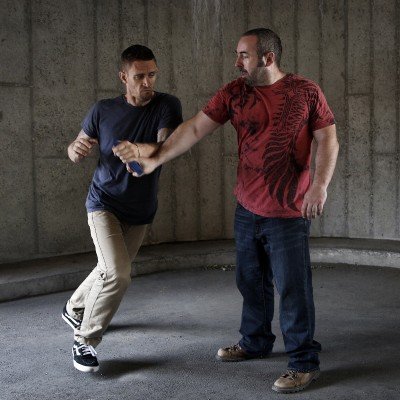
There are many sililarities between the "combative" solutions when dealing with both gun and knife threats e.g., the weapon and/or weapon arm is controlled...
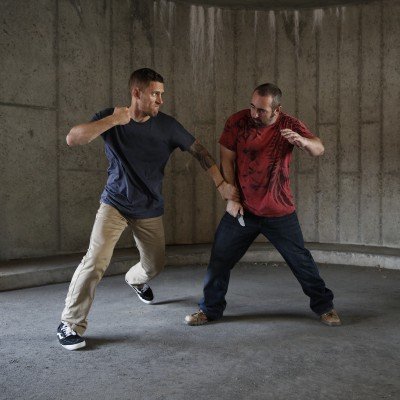
...and striking is used to subdue the attacker. In both cases disarming the weapon is an option but not necessarily the final outcome.
One of the fundamental ideas of Krav Maga, is that the practitioner shouldn’t have to learn a million different ways to deal with similar types of attacks and threats based on how an assailant is positioned reletaive to them.
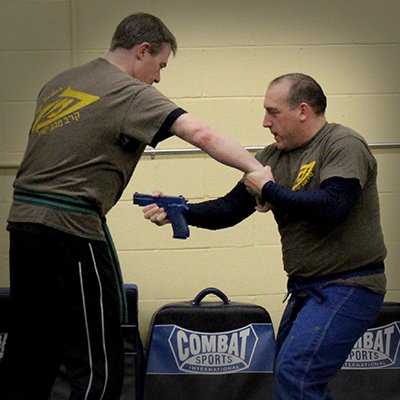 This has several benefits. Firstly more time can be spent practicing than learning, speeding up proficiency e.g., if it takes 10 000 perfect repetitions to master something, and two techniques
for different threats/attacks use almost identical movements, it will only take 5000 repetitions of each to reach this goal, halving the time to achieve mastery etc. Any “new” technique would have
to adhere to this idea, rather than introduce a completely new annd different way of moving. This means that just because there may appear to be a “better” technique for dealing with a threat/attack
it won’t be automatically become a Krav Maga technique unless it conforms or can be ammended to conform to this idea. Krav Maga is much more than a mish mosh of techniques from other martial arts,
it is a systematic approach to fighting that aims to get the averahe person combat-ready in the shortest possible time.
This has several benefits. Firstly more time can be spent practicing than learning, speeding up proficiency e.g., if it takes 10 000 perfect repetitions to master something, and two techniques
for different threats/attacks use almost identical movements, it will only take 5000 repetitions of each to reach this goal, halving the time to achieve mastery etc. Any “new” technique would have
to adhere to this idea, rather than introduce a completely new annd different way of moving. This means that just because there may appear to be a “better” technique for dealing with a threat/attack
it won’t be automatically become a Krav Maga technique unless it conforms or can be ammended to conform to this idea. Krav Maga is much more than a mish mosh of techniques from other martial arts,
it is a systematic approach to fighting that aims to get the averahe person combat-ready in the shortest possible time.
Krav Maga Yashir is just one of several systems of Krav Maga that employ this approach and stays true to the original ideas and fighting concepts developed by Imi Lichtenfeld and his associates. Somebody who teaches Krav Maga will be able to explain solutions based on Krav Maga concepts rather than just simply/teaching a number/set of techniques that seem/appear effective. Whilst nobody should get stuck in the past in order to remain “authentic”, for somebody’s Krav Maga to be relevant, it must stay true to the ideas/concepts laid down by Imi Lichtenfeld and his associates/training partners because these still remain, and have proven to be, true.